OS Foundation
The substrate everything else runs on.
Sales Infrastructure and Marketing Infrastructure don't work without it. The OS Foundation is the agent runtime, data layer, integrations, observability, and governance that makes the rest possible. Read the Business OS Blueprint.
What's actually in the foundation
Five layers. None of them optional.
01 Agent runtime
Where agents are defined, executed, supervised
Identities, permissions, retry logic, time-outs, audit trails. Agents have stable handles you can attach contracts to.
02 Data layer
Warehouse-native, schema-explicit
Owned by you. Agents read from and write to known tables, not opaque vector stores.
03 Integrations
A standardized boundary
Into anything with an API, plus a pattern for the things that don't. We standardize the boundary, not the vendor.
04 Observability
Every run queryable, every decision replayable
Drift is detected, not discovered. Eval cadence ships with the system, not after.
05 Governance
RBAC, secrets, compliance scopes
The boring layer that makes year two real. Configured day one, audited continuously.
The shape
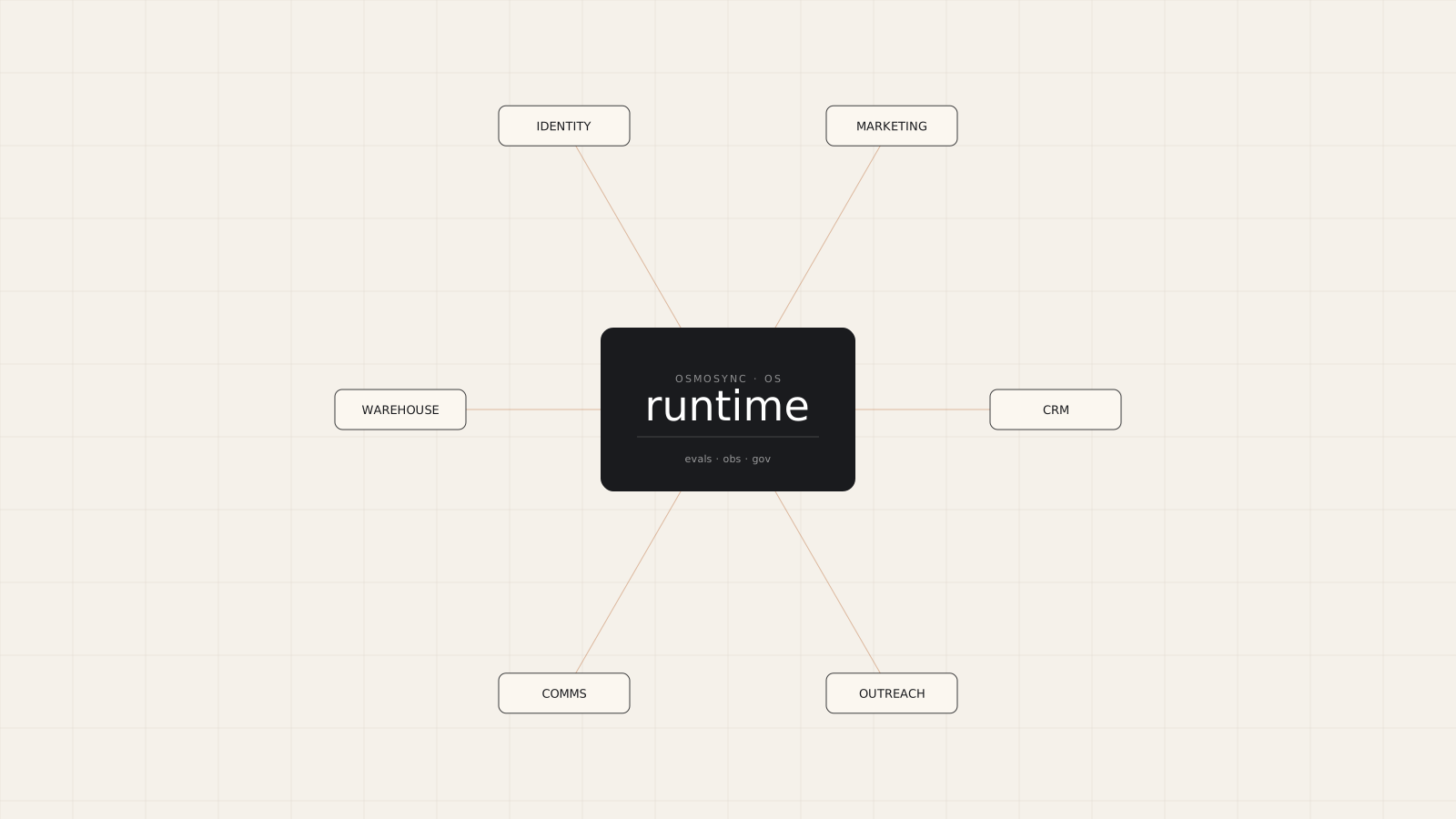
Six surfaces wired into one runtime.
Identity, data, integrations, observability, governance, and pillar surfaces all converge on a shared agent runtime, not loose tools.
Observability, made visible
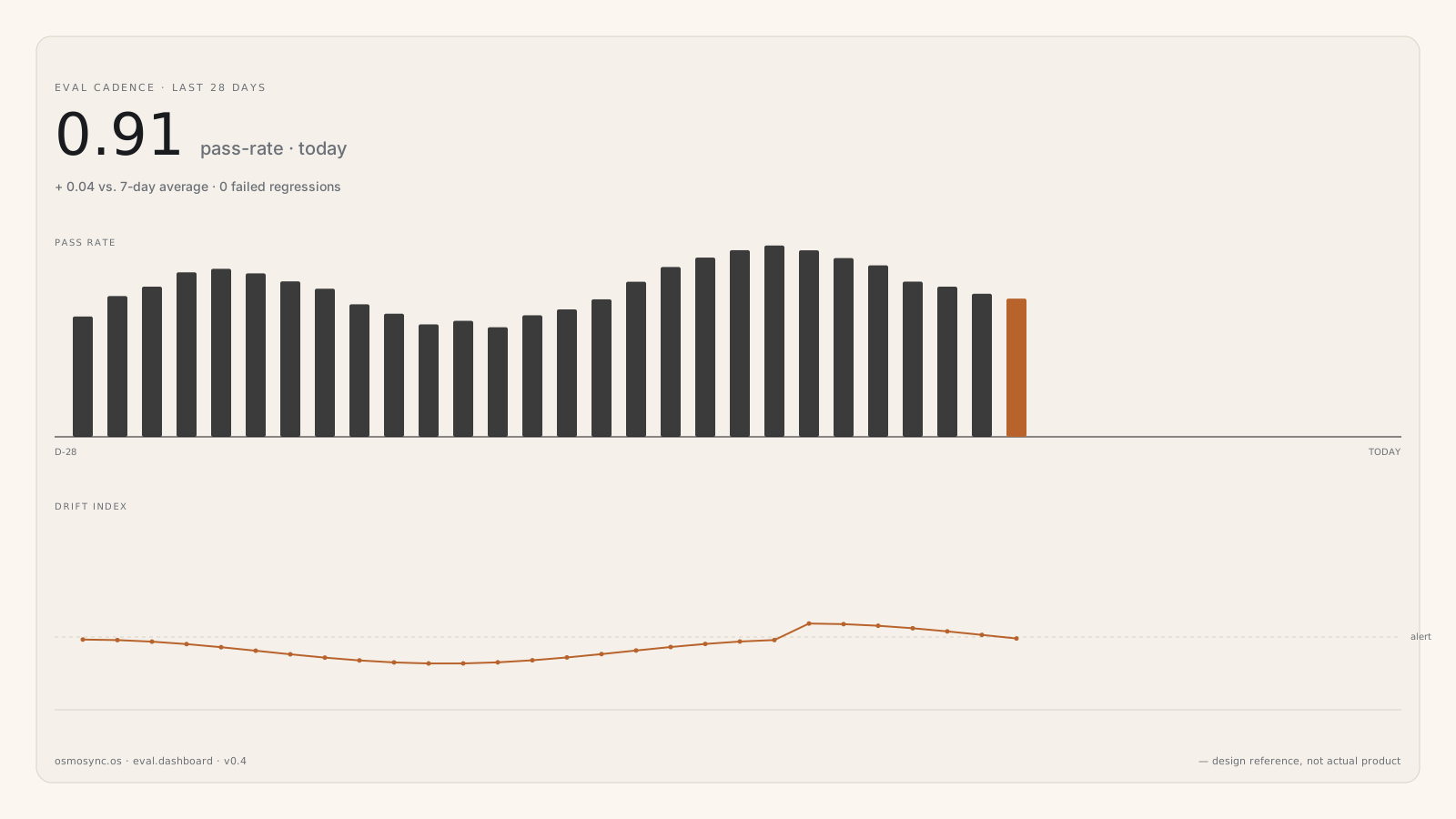
Eval cadence ships with the system, not after.
Pass-rate, drift, and alert thresholds are part of the foundation. You see the line cross before customers do.
How we think about the foundation
Four principles, no decoration.
Agents are first-class citizens, not assistants
They have stable identities and explicit contracts. The runtime treats them as services, not chat sessions.
Humans review at the edges
Decisions above a confidence threshold ship; the rest queue for human review. Not every run needs a human in the middle.
Reversibility is a feature
Every action an agent takes is undoable or compensatable. Production AI without rollback is a liability.
No hidden state
Anything that influences a decision is visible to the people accountable for it. If you can't see why, you can't improve it.
Stack we're fluent in
We don't sell a platform. We pick the right stack.
Honest tooling list. We change it when something better ships.
- Models Anthropic, OpenAI, Gemini, open-weights via vLLM and Ollama
- Data Postgres, Supabase, ClickHouse, BigQuery, Snowflake
- Orchestration LangGraph, Temporal, custom runtimes
- Eval Braintrust, Promptfoo, custom harnesses
- Observability Langfuse, OpenTelemetry, custom
- Integrations Nango, Unipile, direct APIs
How we work
Consult. Build. Scale.
One engagement, three phases. Outcomes shipped, not seats sold.
Consult
Map the foundation that's actually missing.
A 30-minute consultation, then a focused audit. We trace the systems you have, the seams between them, and the agentic surface that should replace the manual middle.
Deliverables
- Stack + workflow audit
- Foundation blueprint
- Build plan with milestones
What we need from you
- Read access to your stack
- 2× working sessions
- A decision-maker on each call
Build
Ship the OS into your stack, not next to it.
We build inside your environment. Data plumbing, agent runtime, integrations, observability, governance, and the pillar layer on top. Weekly demos, no theatre.
Deliverables
- Agent runtime + integrations
- Pillar layer
- Observability + governance
What we need from you
- Engineering point of contact
- Sandbox environment
- Domain experts for evals
Scale
Operate, improve, and compound.
We run with you. Monitor traces, ship evals, expand the agent surface, retire what doesn't earn its place. Outcomes shipped, not seats sold.
Deliverables
- Eval + observability cadence
- Quarterly roadmap
- New surfaces shipped monthly
What we need from you
- Outcome targets
- Quarterly reviews
- Trust to retire dead workflows
What you keep
Your code, your agent definitions, your eval harness, your observability data. We don't ship SDKs you can't replace.
Questions
The questions sophisticated buyers ask before they commit.
Four answers. The full library lives at the homepage Q&A.
Q1 What are the six layers of an AI Operating System?
What are the six layers of an AI Operating System?
Context and data, real-time intelligence, automation, agents, command center, and mobile autonomy. Each layer does a specific job. Each layer reads from the layers below it. Skip a layer and the layers above inherit the gap. Most teams that fail start at automation and pretend they have an OS.
Q2 Why is a foundation necessary if our agents already work?
Why is a foundation necessary if our agents already work?
Most companies stack AI on a business that has no foundation for it. Pile automations on tools on agents, and the whole thing wobbles the moment something new ships. The foundation is what lets every new piece slot in cleanly while the rest keeps running.
Q3 Is a vector store a data layer?
Is a vector store a data layer?
No. A vector store is a cache over an embedding function, not a system of record. Holding the truth in a system the company already trusts (warehouse, CRM, object store) and treating the index as a derived view is what makes Layer 1 actually load-bearing.
Q4 What happens when a model improves or a vendor gets disrupted?
What happens when a model improves or a vendor gets disrupted?
The OS continues. Models and tools live inside the layers and behind the integration boundary. Swap them out without touching the surrounding system. Every other approach to AI rebuilds with every cycle. The OS absorbs cycles.
Ready?
Build the foundation first.
30-minute consultation. Bring your real architecture. We'll tell you what's missing and what we'd ship in the first 8 weeks.