Marketing Infrastructure
Marketing as a system, not a department.
We build the production, distribution, and measurement layer that runs marketing as infrastructure. Content engines, audience pipelines, lifecycle, attribution, all as one coherent layer. Read the Marketing OS playbook.
Why generic AI content fails
Generators ship drafts. Your audience is downstream of a system.
Three reasons "AI marketing" hasn't produced compounding pipeline for B2B teams. None of them are about the model.
Volume without taste is noise.
AI content tools optimize for output. They don't know your voice, your positioning, or what your audience has already heard.
Distribution is its own system.
Most "AI marketing" stops at the draft. The hard part, getting the right thing to the right audience at the right moment, remains a manual job.
Attribution is fiction in most B2B.
Last-touch dashboards lie. If you can't trace what produced a meeting, you can't improve.
What we build
Production, distribution, measurement.
One layer. Same data, same audit trail, same governance as the rest of the foundation.
01 Content engines
Voice-aware production
Voice-aware production pipelines that draft, refine, and ship across channels. Editorial quality, not template fill.
02 Audience pipelines
Owned audience, unified data
Newsletter, community, owned audience growth. Subscriber data unified with the rest of the GTM stack.
03 Lifecycle
Triggered by real signals
Onboarding, nurture, re-engagement, churn detection. Triggered from real signals, not arbitrary delays.
04 Attribution
Multi-touch, warehouse-native
Multi-touch, warehouse-native, attached to revenue. Marketing reports from the same data the agents write to.
What it looks like
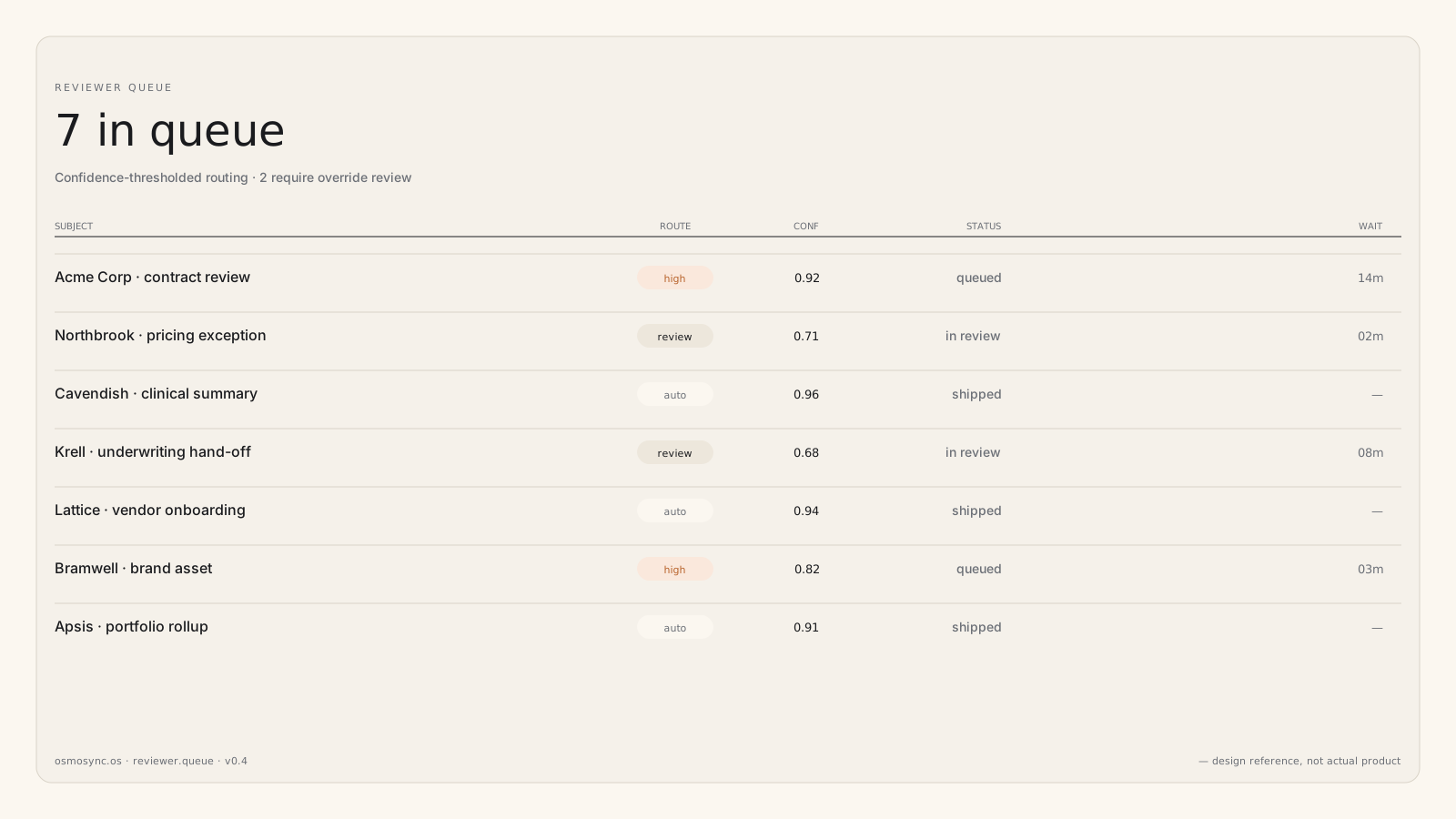
Human review at the edges, not in the middle.
Above a confidence threshold, content ships. The rest queues here, routed by topic, with the trace and the source. No batch QA spreadsheet.
Why this works for B2B
B2B marketing is long-cycle and low-volume per account. The system needs to remember, not just produce. We build for the cycle, not the campaign.
How we work
Consult. Build. Scale.
One engagement, three phases. Outcomes shipped, not seats sold.
Consult
Map the foundation that's actually missing.
A 30-minute consultation, then a focused audit. We trace the systems you have, the seams between them, and the agentic surface that should replace the manual middle.
Deliverables
- Stack + workflow audit
- Foundation blueprint
- Build plan with milestones
What we need from you
- Read access to your stack
- 2× working sessions
- A decision-maker on each call
Build
Ship the OS into your stack, not next to it.
We build inside your environment. Data plumbing, agent runtime, integrations, observability, governance, and the pillar layer on top. Weekly demos, no theatre.
Deliverables
- Agent runtime + integrations
- Pillar layer
- Observability + governance
What we need from you
- Engineering point of contact
- Sandbox environment
- Domain experts for evals
Scale
Operate, improve, and compound.
We run with you. Monitor traces, ship evals, expand the agent surface, retire what doesn't earn its place. Outcomes shipped, not seats sold.
Deliverables
- Eval + observability cadence
- Quarterly roadmap
- New surfaces shipped monthly
What we need from you
- Outcome targets
- Quarterly reviews
- Trust to retire dead workflows
What you keep
Your audience list, your content rights, your attribution model. The system runs on your warehouse.
Questions
The questions sophisticated buyers ask before they commit.
Four answers. The full library lives at the homepage Q&A.
Q1 How is this different from a Zapier, Make, or n8n marketing stack?
How is this different from a Zapier, Make, or n8n marketing stack?
Those tools are Layer 3 only. They wire automations together. They have no Layer 1 (no context, they don't know your business), no Layer 2 (no live signal, they don't know what is happening right now), and no Layer 4 (no agents that can decide). They run scripts. A Marketing OS runs functions.
Q2 Will the voice stay consistent across every channel?
Will the voice stay consistent across every channel?
Yes. One editorial brain feeds newsletter, LinkedIn, YouTube, lead magnets, and community. Voice and ICP live in Layer 1, every component reads from the same brain. Update the brain, every channel inherits the change. Voice drift is an architecture problem, and the architecture removes it.
Q3 What if my pricing, ICP, or offer changes?
What if my pricing, ICP, or offer changes?
Context changes are edits to Layer 1. New offer, new ICP, new pricing, new SOP, update the brain, every agent and automation downstream inherits the change automatically. That is the entire point of the architecture.
Q4 Do I own the marketing OS after it ships?
Do I own the marketing OS after it ships?
Yes. The OS lives in your environment, your accounts, your data, your domains. Your context, your agents, your asset, permanently. No rented runtime, no vendor lock.
Ready?
Run marketing as infrastructure.
30-minute consultation. Bring real audience data and a real number you want to move. We'll tell you what we'd build.